

Most career astrology focuses on the 10th house. But I think that's only part of the picture.
Your 10th house can tell you a lot about your career direction, reputation, and how you show up in the world. But it doesn't necessarily explain why a job that looks great on paper still leaves you drained — or why you can be successful at something and still feel like something is missing.
That's where the 2nd and 6th houses come in.
Together, I think of the 2nd, 6th, and 10th houses as your Career Trinity — because they show three very different parts of your working life:
- 2nd House: What you value, what makes work feel worth it, and what you need to feel secure
- 6th House: How you need to work day to day and what you can realistically sustain
- 10th House: Where your career is taking you, how you're seen, and the kind of contribution you want to make
If your career looks right on paper but still doesn't quite fit, looking at these three houses together can help you understand where the disconnect may be.
What Do the 2nd, 6th, and 10th Houses Mean for Your Career?
Think of these three houses as answering three different career questions:
- 2nd House — What makes work worth it?
Your money, values, resources, sense of security, and what you need to feel properly compensated or supported. - 6th House — How do you need to work?
Your daily routines, workload, work environment, responsibilities, and what you can realistically sustain over time. - 10th House — Where are you headed?
Your career direction, public reputation, visibility, and the kind of contribution you may become known for.
Together, they can help you see whether the problem is what you're doing, how you're doing it, or what you're getting from it.
Which House Represents Career in Astrology?
The 10th house is the primary house associated with career in astrology, including your professional direction, reputation, and public life. But it doesn't tell the whole story. The 6th house shows how you need to work day-to-day, while the 2nd house adds information about money, values, resources, and security.
That's why I like to look at all three together when exploring career fit.
How the 2nd, 6th, and 10th Houses Work Together
Each of these houses tells you something different about your working life.
Think of your 2nd house as your foundation. It speaks to money, values, resources, and what you need to feel secure. This is where you start to see whether the work you're doing actually feels worth it to you.
Your 6th house is your engine. It describes the reality of your day-to-day work: your routines, responsibilities, work environment, and the conditions that help you function well over time.
And your 10th house is your destination. It reflects your career direction, public reputation, visibility, and the kind of contribution you may ultimately want to be known for.
A career can look successful from the outside and still feel wrong when one of these pieces isn't working.
That might look like:
- A high-paying role that leaves you drained every day.
- A job you genuinely enjoy that doesn't give you enough financial security.
- A comfortable work environment that isn't taking you anywhere you actually want to go.
Looking at the three houses together can help you identify where the mismatch actually is.
The 2nd House: Money, Values, and What Makes Work Feel Worth It
Your 2nd house speaks to money, resources, values, and your relationship with security.
In career astrology, I find it especially useful for answering a question that often gets overlooked:
What do I actually need to get back from my work for it to feel worth doing?
That might mean financial stability. But it can also mean autonomy, recognition, meaningful compensation, a sense that your skills are valued, or simply knowing that the energy you're putting into your work is giving you something important in return.
For me, this has been one of the more complicated parts of my own chart.
I have Libra on my 2nd house, with Pluto there, and I've spent a lot of my career trying to reconcile two very real needs: the desire for stability and the feeling that staying somewhere solely because it looks secure can come with its own cost.
I've had jobs that looked very safe on paper — steady income, good benefits, respectable roles — and still found myself questioning whether that version of security was actually enough.
That's why I don't think the 2nd house is simply about how much money you make.
It's also about what you value enough to build your working life around — and what you need in return for your effort to feel sustainable and worthwhile.
How to Explore Your 2nd House
If you want to understand your own 2nd house story, start with three layers: the sign of the house, its planetary ruler, and any planets placed there.
1. Look at the sign of your 2nd house
Start by finding the sign associated with your 2nd house.
That sign describes the general style through which you approach money, resources, security, and value. In a career reading, I like to think of it as a clue to what you may need in order for work to feel worthwhile and adequately supportive.
For example:
- Aries may place a high value on independence, initiative, and having room to create opportunities for yourself.
- Libra may care deeply about fairness, reciprocity, and whether the exchange between effort and reward actually feels balanced.
- Pisces may place more value on meaning, creativity, compassion, or work that feels connected to something larger.
These are only starting points. The ruler of your 2nd house will tell you much more about how those themes actually show up in your chart.
2. Find the ruler of your 2nd house
Once you know the sign of your 2nd house, find the planet that rules that sign.
Then ask three questions:
- What sign is the ruler in?
This describes how the planet tends to operate. - What house is the ruler in?
This can show the area of life where your 2nd-house themes around money, resources, value, and security become connected to the rest of your chart. - What aspects does the ruler make?
Aspects from other planets can modify, support, complicate, or intensify the way the ruler functions.
I rarely stop at the sign alone. Following the ruler is often where the chart starts becoming much more personal.
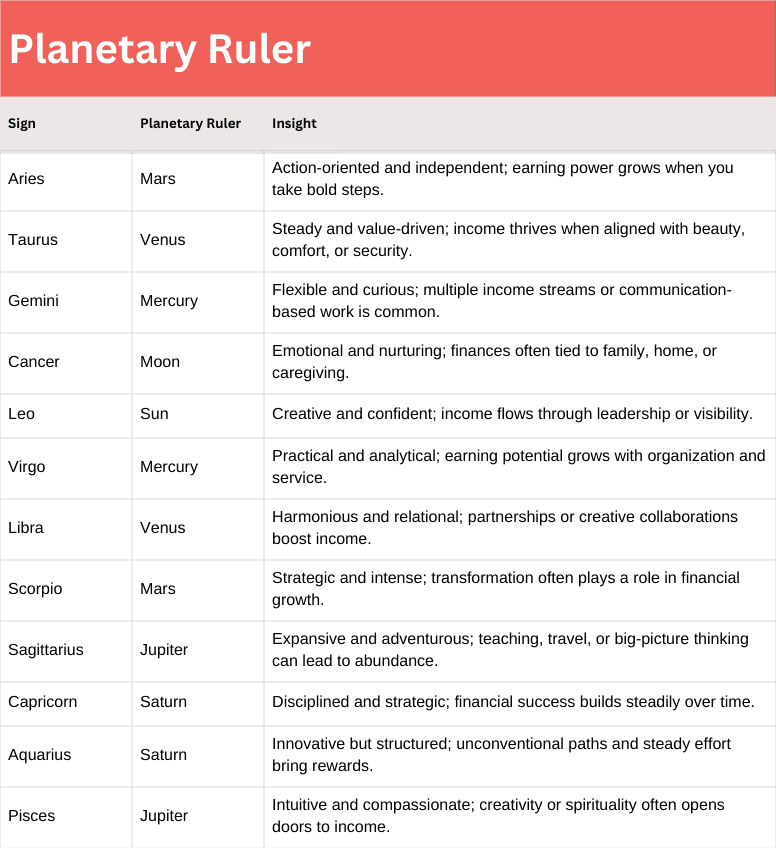
For example, if you have Libra on your 2nd house, Venus is your ruler. If Venus is in your 3rd house, your 2nd-house themes around money, resources, and value become connected to 3rd-house topics like communication, learning, writing, siblings, or your local environment.
Exactly how that connection shows up will depend on Venus’s sign, condition, and aspects — which is why the ruler gives you a much more personalized picture than the 2nd-house sign alone.
3. Note Any Planets in the 2nd House
If you have planets in your 2nd house, they add another layer to your relationship with money, resources, security, and value.
For example, the Moon can make emotional and material security closely connected. Saturn may bring lessons around patience, responsibility, or building security over time. And Pluto can make money, resources, and self-worth areas of deeper transformation.
The planet’s sign, condition, aspects, and rulerships will refine the story even further.
The important thing isn't to read a planet in the 2nd house as a prediction about how much money you'll make. It's to ask how that planet changes your relationship with value, resources, security, and what feels worth investing your energy in.
Want to Go Deeper With Your Own Chart?
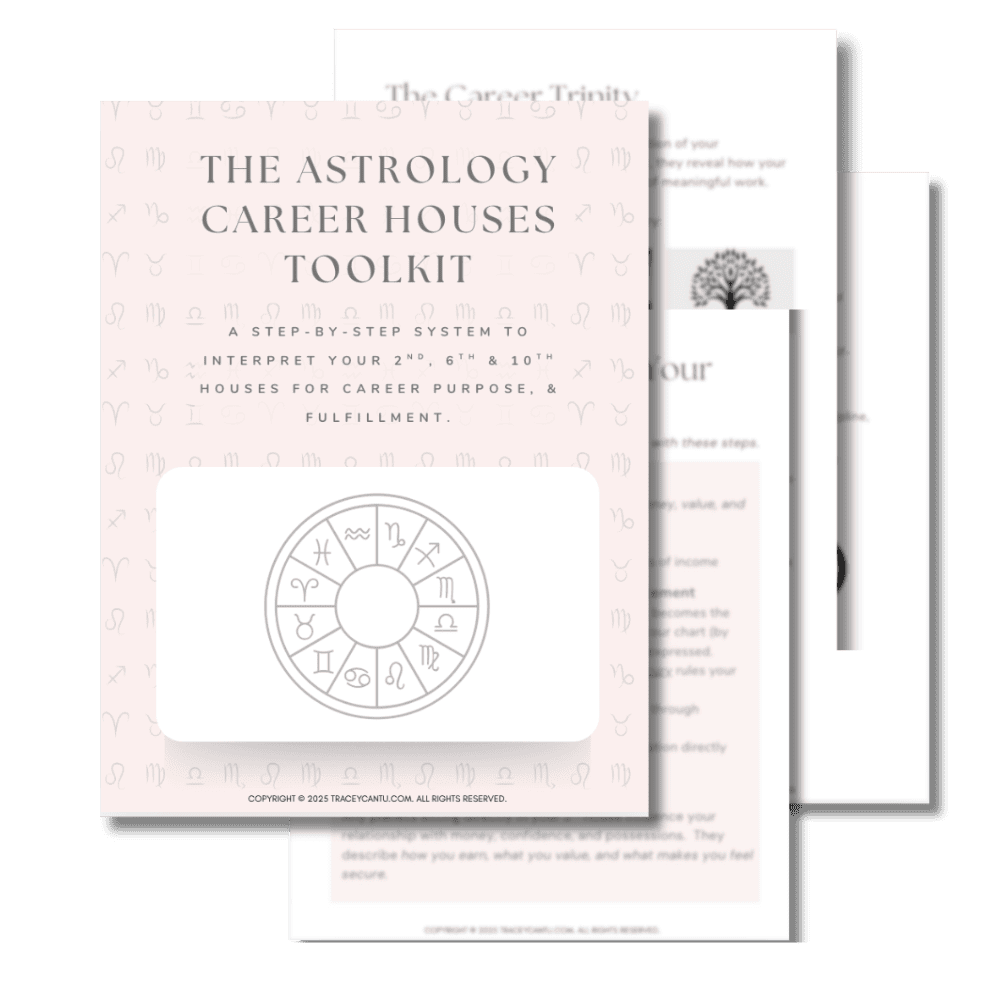
If you’re feeling stuck or burned out, your birth chart can explain why. Get sign-by-sign and planet-by-planet interpretations to help you decode your own career story — including what drives you, what’s sustainable, and the kind of work you’re meant to do.
The 6th House: Work Rhythms, Daily Routines, and What You Can Sustain
If the 2nd house shows what you value and what helps you feel secure, the 6th house shows what your working life actually needs to look like day to day.
It speaks to your routines, workload, habits, work environment, responsibilities, and the way you use your energy. It can also show where your daily life supports your well-being—or where your routines start working against you.
For me, with Aquarius in the 6th house, independence and flexibility have always been incredibly important. A rigid schedule—especially one where someone else controls when and where I work—can feel much more draining to me than the work itself.
I saw this especially clearly when my company required a return to the office full-time. My reaction wasn't simply, I don't like commuting. My entire daily rhythm suddenly felt incompatible with the way I function best.
I've realized that I do much better when I have room to structure my day around the way my energy naturally moves: time to think, space to write, breaks to walk or reset, and enough flexibility that every hour doesn't feel predetermined.
That’s one of the reasons I find the 6th house so useful. Sometimes the problem isn't what you're doing for work. It's the way you're being asked to do it.
How to Understand Your 6th House
To understand your 6th house, start with three layers: the sign, its planetary ruler, and any planets in the house.
1. Look at the sign of your 6th house
The sign gives you clues about the kind of rhythm, environment, and working style that may feel most natural to you.
For example:
- Virgo may appreciate structure, useful systems, and a sense that things are being done well.
- Aquarius may need independence, flexibility, and room to approach work differently.
- Cancer may be especially sensitive to the emotional tone of the work environment and need a greater sense of support or belonging.
The question isn't simply, What job should I have?
It's: What conditions help me function well on a normal Tuesday?
2. Find the ruler of your 6th house
Next, find the planet that rules your 6th-house sign and see where it falls in your chart.
The ruler can show where your themes around work, routines, responsibility, and sustainability connect to the rest of your life.
For example, if Aquarius is on your 6th house, Saturn is its traditional ruler. If Saturn is in your 1st house, your 6th-house themes become connected with 1st-house topics like identity, your body, and the way you move through the world.
This is where the interpretation starts becoming much more personal than the 6th-house sign alone.
3. Note Any Planets in the 6th House
Planets in the 6th house add another layer to your relationship with work, routines, responsibility, and daily life.
For example, Mars may bring more urgency, drive, or a tendency to push hard. Saturn can emphasize responsibility, discipline, or the need to build sustainable routines over time. Neptune may make boundaries around work, service, and what you're responsible for especially important.
The planet's sign, condition, aspects, and rulerships will refine the story even further.
And if your 6th house is empty, that doesn't mean it isn't important. Simply place more emphasis on the sign and its planetary ruler.
The goal isn't to interpret a planet in the 6th house as a specific job. It's to ask how that planet changes the way you experience work, responsibility, routines, and the demands of everyday life.
The 10th House: Career Path, Public Life, and Legacy
If the 2nd house shows what you need from work and the 6th house shows how you function day to day, the 10th house speaks to your broader career direction, public reputation, and the kind of work you may become known for.
This is the house people most often associate with career — but I find it especially useful for understanding the bigger question of where your professional life seems to be taking you.
For me, with Gemini in the 10th house, my path has never felt especially linear. I've moved through different interests and roles, but certain themes keep repeating: communication, learning, writing, sharing ideas, and needing enough variety that I don't feel boxed into one narrow lane.
That's what I find so useful about the 10th house. It doesn't necessarily hand you a job title.
It can show you the themes, direction, and kind of contribution that keep resurfacing throughout your career.
How to Understand Your 10th House
Start with the same three layers we've used for the other career houses: the sign, its planetary ruler, and any planets in the 10th house.
1. Look at the sign of your 10th house
The sign gives you a starting point for understanding the style, qualities, or themes that may shape your public and professional life.
For example:
- Gemini may point toward communication, learning, adaptability, or a career with multiple interests or chapters.
- Capricorn may emphasize responsibility, structure, long-term development, or building credibility over time.
- Leo may bring themes of visibility, creativity, leadership, or personal expression.
The sign doesn't tell you exactly what career to choose. Think of it more as a clue to how your public path tends to express itself.
2. Find the ruler of your 10th house
Next, find the planet that rules your 10th-house sign and look at where that planet falls in your chart.
This is one of the most important steps because the ruler can show where your career and public-life themes connect to the rest of your chart.
For example, if Gemini is on your 10th house, Mercury is the ruler. If Mercury is in the 3rd house, your 10th-house themes become connected with 3rd-house topics such as communication, writing, learning, information, or your immediate environment.
Exactly how that connection shows up will depend on Mercury's sign, condition, and aspects.
3. Note any planets in the 10th house
Planets in the 10th house add another layer to your career direction, public role, and reputation.
For example, the Sun can make visibility or public contribution more closely tied to identity. Mercury may bring communication, ideas, learning, or analysis into your professional reputation. Saturn can emphasize responsibility, credibility, and a career path that develops through persistence and time.
The planet's sign, condition, aspects, and rulerships will refine the story even further.
And if your 10th house is empty, that doesn't mean career isn't important in your chart. Simply place more emphasis on the 10th-house sign and its ruler.
The goal isn't to treat a planet in the 10th house as a specific career prediction. It's to ask how that planet changes the way you experience visibility, ambition, reputation, and your larger professional direction.
When Your 2nd, 6th, and 10th Houses Don’t Align
The real value of looking at these houses together is that they can help you understand where a career mismatch may actually be coming from.
You might have a career that fits one part of your chart beautifully while completely missing another.
For example:
- Your 10th house fits, but your 6th house doesn't: You may like the work itself or feel good about where your career is going, but the schedule, environment, workload, or way you're expected to work is exhausting you.
- Your 6th house fits, but your 2nd house doesn't: You may enjoy your day-to-day work but feel underpaid, undervalued, financially insecure, or like you're giving more than you're getting back.
- Your 2nd house fits, but your 10th house doesn't: The job may give you security, good compensation, or the things you've been taught to value, but the direction itself no longer feels like where you want to go.
And sometimes, more than one piece is off.
That's why asking only “What career should I have?” can miss the real problem.
A better place to start might be:
Is it what I'm doing, how I'm doing it, or what I'm getting from it that no longer fits?
Your 2nd, 6th, and 10th houses can help you start separating those answers.
Conclusion
The 10th house may be the house most associated with career, but it doesn’t tell the whole story.
Your 2nd house can show what you need from work for it to feel worthwhile and secure. Your 6th house can help you understand the kind of daily work life you can realistically sustain. And your 10th house speaks to the larger direction your career is taking and what you may become known for.
Looking at all three together can help you ask a much more useful question than “What career am I supposed to have?”
Instead, you can start asking:
What part of my working life actually isn’t fitting anymore?
Is it what you’re getting from your work?
The way you’re being asked to work?
Or the direction your career is taking you?
Sometimes that distinction alone can make the next step a lot easier to see.
If you’re ready to go a bit further, you might want to explore my guide to the 2nd, 6th, and 10th houses. It’s a toolkit designed to help you uncover what drives you, what drains you, and what kind of work is truly sustainable — straight from your own birth chart.
Frequently Asked Questions
Which house represents career in astrology?
The 10th house is the primary house associated with career in astrology. It speaks to your professional direction, public reputation, visibility, and what you may become known for over time.
But career isn't only a 10th-house topic. Your 6th house can show how you need to work day to day, while your 2nd house adds information about money, values, resources, and security. Looking at all three can give you a much fuller picture of career fit.
What is the difference between the 6th house and the 10th house for career?
The 6th house describes the reality of your everyday working life: routines, workload, responsibilities, work environment, and what you can realistically sustain.
The 10th house describes your broader professional direction, public reputation, visibility, and the roles or contributions you may become known for.
Put simply: the 6th house is how you work; the 10th house is where your career is going.
What does the 2nd house have to do with career?
The 2nd house relates to money, resources, values, and security. In a career reading, it can help you understand what you need to receive from your work for it to feel worthwhile — whether that's financial stability, fair compensation, autonomy, recognition, or something else you deeply value.
It can be especially helpful when a job looks successful on paper but still doesn't feel worth the tradeoff.
How do the 2nd, 6th, and 10th houses work together?
Think of the three houses as answering three different questions:
- 2nd House: What do I need from my work?
- 6th House: How do I need to work?
- 10th House: Where is my career taking me?
Looking at them together can help you identify whether a career mismatch is coming from what you're getting from your work, the way you're being asked to work, or the direction your career is moving.
How do I find my 2nd, 6th, and 10th houses?
Start with your birth chart and locate the 2nd, 6th, and 10th houses. Note the sign associated with each house, then find the planet that traditionally rules that sign.
From there, look at:
- The sign of the house
- The planetary ruler and where it falls in your chart
- Any planets placed in the house
Reading these layers together will give you much more information than looking at the house sign alone.
What if my 2nd, 6th, or 10th house is empty?
An empty house does not mean that area of life is unimportant or inactive.
If you don't have planets in your 2nd, 6th, or 10th house, start with the sign of the house and its planetary ruler. The ruler's sign, house placement, condition, and aspects can tell you a great deal about how that house functions in your chart.
About Tracey

Tracey Cantu is a soul-centered astrological guide who blends 15+ years of strategic marketing experience with the study of Hellenistic astrology. She specializes in whole-sign houses, classical aspects, and traditional rulerships, translating birth chart patterns into clear, practical guidance around career, burnout, self-worth, and soul-aligned direction. When she isn’t reading charts or writing about astrology, Tracey can be found thrifting hidden gems, tackling DIY projects, and spending time with her family in San Francisco.




OMG! I have 2nd, 6th and 10th Houses like your. Pluto in 2nd, Stellium in Scorpio… (Venus, Mercury, Sun, Uranus and Mars. I have moved country last year. I’m trying to find a new carrer path, maybe you can help me.
I believe we have very similar charts.
Sophie! That’s amazing — I love hearing about similar charts and how things play out. I’d love to hear more about your story and what’s going on with you right now. I’m hoping to launch a career report after the first of the year that could be really helpful. It’s actually a big part of what led me to this work, once it became so clear that what I was doing before was very much not aligned 🙂. Stay tuned, and feel free to sign up for my email list if this resonates with you at all. Best of luck!!
Hi!!!! I just found your article and i feel like a light bulb just fired up. I also have the same chart. 2nd in Libra (Sun, Moon, Venus and Mercury, also south node), 6th Aquarius, and 10th Gemini with MC and Chiron. My Pluto is in my 3rd House. Lilith & Part of fortune is in 12th. Jupiter and North Node and Vertex in 8th Aries. I feel compelled to write, teach, but do all sorts of things which doesnt make sense to other people. I also feel lost. I work in a corporate (data) but i feel like there is more for me out there and no matter what i achieve, i still feel the void. And, my constant ask is “What will i do with my life” which my friends have gotten tired of.
Kathleen! Thanks so much for writing in…and hello, fellow Virgo rising!
Wow, you have a strong 2nd house stellium, especially with that well-supported Venus. I also 1000% understand the feeling that there’s more. Don’t ignore it. With your Sun + 2nd house emphasis, I’d ask: What do I genuinely value, and what do I want to contribute that feels like an expression of who I am? Maybe there’s a connection to your 9th house and teaching, as you mentioned (because of Taurus being connected to Venus too)..
Food for thought, and remember, figuring it out is part of the journey. Good luck!